12 Is The New Five: The Math That Just Killed Average Private Equity
Cheap leverage and multiple expansion once did most of the heavy lifting. Today, private equity must earn returns the difficult way: through sustained operational growth.

In 2015, a sponsor buying a company at 10 times EBITDA, financing half the purchase price with debt priced around 6%, and exiting five years later at 12.5 times EBITDA needed only 5% annual EBITDA growth to deliver a 2.5x MOIC.
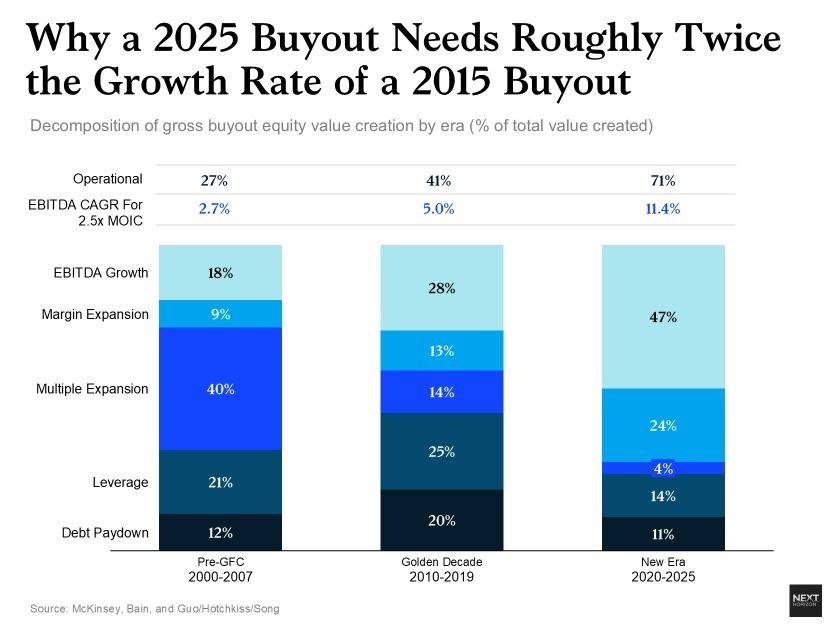
Run the identical arithmetic on a 2025 buyout, entry multiples near 14 times, leverage down to roughly a third of enterprise value, debt priced near 8%, and the growth rate required to clear the same 2.5x bar rises to approximately 11%. Bain & Company states this comparison in its 2026 Global Private Equity Report as a rule of thumb: 12 is the new 5. We rebuilt the underlying LBO model independently rather than take the conclusion on faith, and it holds: across a wide range of entry multiples (10x–13x), exit assumptions, leverage levels, and interest rates, the growth rate a 2025 vintage needs to match a typical 2015 deal clusters between 9% and 15%, never close to 5%.
This is not a cyclical dip. It is a structural repricing of how private equity returns get made.
What changed
Three inputs moved at once, and each used to work in the sponsor's favor. Entry multiples, which averaged roughly 9x EBITDA across 2010–2022 according to McKinsey's Global Private Markets Report, reached a record 11.8x in 2025. Debt got both more expensive and less available: McKinsey reports debt financed 37% of the typical entry multiple in 2025, down from a 44% average between 2010 and 2022, even as benchmark LBO borrowing costs sit several points above the near-zero base rates that prevailed through most of the 2010s. And the tailwind that used to paper over both problems, buying low and selling high on the multiple alone, has gone flat: roughly 80% of GPs surveyed by Bain and StepStone in early 2026 expect multiples to hold, not expand.
Where the returns actually came from
The scale of the shift shows up cleanly in return-decomposition data. McKinsey, citing StepStone Group analysis, finds that for buyout vintages completed between 2010 and 2022, leverage and multiple expansion together accounted for 59% of investor returns, operating performance supplied the remaining 41%. Go back further, to the 1990–2006 buyout wave studied by Guo, Hotchkiss and Song in the Journal of Finance, and the pattern holds in kind: rising industry valuation multiples and the tax benefits of added leverage were, in the authors' framing, each about as important as operating gains in explaining realized returns.
That balance has now inverted. McKinsey reports that specialist buyout funds, managers with real sector depth, derived just 5% of their 2010–2022 returns from multiple expansion, versus 35% for generalists, while generating roughly four times as much value from margin expansion. Specialists also posted higher pooled IRRs (17% vs. 13%) and lower loss ratios. Separately, Bain reports that revenue growth alone accounted for 71% of value created in company exits completed in 2024, up from 64% the year before.
We can triangulate this independently. Solving our own model for the EBITDA growth a 2025 deal needs to reach 2.5x, then decomposing that deal's value creation the same way McKinsey decomposes realized deals, produces a growth share of roughly 75% of total equity value created, a forward-looking, assumption-driven estimate landing within a few points of Bain's backward-looking, realized-deal figure of 71%. Two unrelated methods converging on the same order of magnitude is the kind of confirmation that should update anyone's prior.
The industry is already repositioning, not just talking about it
McKinsey finds that operating groups at private equity firms have, on average, more than doubled in size since 2021, independent of fund size, meaning this is a structural buildout, not a byproduct of AUM growth. KKR's Capstone platform, founded in 2000 as a small team, now runs roughly 100 full-time operating professionals across every strategy the firm runs. Vista Equity Partners' internal consulting group numbers over 200. Apollo's own 2026 commentary is explicit that the prior decade's returns "could substitute for genuine value creation" with cheap debt and multiple expansion, and frames the current environment as private equity returning to its roots. KKR's macro team describes its own capital allocation as favoring operational alpha over beta. The capability build predates and outsizes the messaging.
The paradox LPs should sit with
Dry powder is near record levels, global buyout funds have raised $1.8 trillion since 2022, while deal counts fall and holding periods stretch toward seven years, up from five to six years for most of 2010–2021. Distributions as a share of net asset value sit at roughly 14%, a level last seen during the 2008–09 crisis, for a fourth consecutive year. GPs are not short of capital or ideas; they are short of the one input, realized, organic EBITDA growth at scale, that multiple expansion used to make optional.
The takeaway
Multiple expansion did not disappear because sponsors got worse at buying companies. It disappeared because rates reset and multiples never came back down to meet them. Every point of that gap now has to be earned inside the business, not at the closing table. For LPs, that means underwriting the operating platform, not just the historical IRR. For GPs, it means the value-creation plan is the deal, not an appendix to it.