India’s Lawsuits Are Becoming Investable - Litigation Funding via AIFs
Litigation finance is emerging as a new alternative asset class in India, with institutional capital beginning to back legal claims and recoveries.

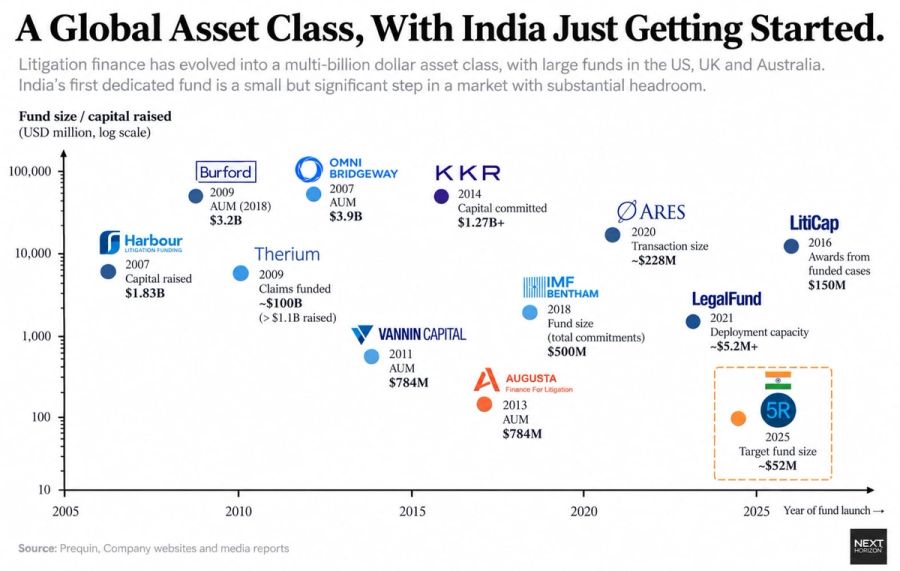
India’s litigation-finance market is beginning to acquire the characteristics of an alternative asset class. The global litigation-funding investment market was estimated at US$23.58 billion in 2024 and is projected to reach US$64.76 billion by 2035, implying a 9.62% CAGR. Against this backdrop, India is beginning to build its own institutional market. Five Rivers Capital Fund I, with a target corpus of ₹500 crore, is the first Alternative Investment Fund regulated by SEBI to launch in India specifically to invest in legal-finance assets. At the same time, ₹4.38 lakh crore was involved in 1,878 pending insolvency avoidance applications as of March 2026, pointing to a potentially sizeable pool of claims that may require capital to be monetised.
For most investors, a lawsuit remains an expense. Legal fees accumulate, capital remains tied up and the outcome can take years to determine. Litigation finance introduces a different proposition: a legal claim can itself become an investable asset. A third-party funder provides capital to pursue a claim in exchange for a share of the eventual recovery. If the case fails, the funding is generally non-recourse, meaning the claimant does not repay the capital. The investor, rather than the claimant, bears the investment risk.
This is the model Five Rivers is now bringing into an institutional fund structure in India. Five Rivers Capital Fund I is a SEBI-registered Category II AIF with a target size of ₹500 crore, managed by Fivcap India Advisors. The fund completed its initial close on 4 December 2025 and has a final close scheduled for December 2027. It intends to make between 10 and 18 investments across different case types and tribunals, rather than rely on a single litigation outcome. The distinction matters. This is not simply a new way of paying legal bills. It is an attempt to apply private-market underwriting to legal claims. Five Rivers says it evaluates cases on legal merits, claim size, enforceability, counterparty risk and expected duration. Its stated focus is on claims worth at least US$15 million, or approximately ₹125 crore, with a preferred resolution period of five years or less.
For an alternative investor, the attraction lies in the source of the underlying return. Litigation outcomes are not directly determined by equity valuations, interest rates or corporate earnings. The investment instead depends on the probability of a successful claim, the size of the eventual recovery, the time taken to reach a resolution and the ability to enforce the outcome. That makes litigation finance a form of event-driven investing, with potentially significant upside but a distinctive set of risks.
The global market suggests that institutional capital is becoming increasingly comfortable with the concept. Litigation finance has developed from a specialist practice in markets such as Australia, the United Kingdom and the United States into a multi-billion-dollar industry. A 2025 academic review describes third-party litigation funding as having evolved from a niche concept into an alternative investment strategy involving specialist fund managers, hedge funds and institutional investors.
India, however, is still at the beginning of this process. The country's enormous volume of litigation creates a large theoretical opportunity, but the number of cases is not itself an investment thesis. Most disputes will never be suitable for institutional funding. What matters is whether a claim has sufficient economic value, strong legal merits and a credible route to recovery. Commercial litigation, arbitration, insolvency and enforcement proceedings are therefore likely to be among the earliest areas of institutional adoption.
The insolvency market is particularly interesting. As of 31 March 2026, 1,878 avoidance applications under the Insolvency and Bankruptcy Code involved more than ₹4.38 lakh crore. These proceedings can require substantial legal, investigative and forensic expenditure before any recovery is realised. The Ministry of Corporate Affairs is now examining whether third-party funding could be used to pursue preferential, undervalued, fraudulent and extortionate transactions, commonly referred to as PUFE matters.
That development could prove more consequential than litigation funding as a standalone investment product. An insolvency estate may contain a legitimate claim but lack the capital required to pursue it. External funding effectively converts that unfunded claim into a financeable recovery opportunity. The investor supplies capital today against the possibility of receiving a portion of a recovery several years later. The economics therefore resemble neither conventional private equity nor private credit. There is no operating company generating EBITDA and no contractual coupon protecting the investor. Instead, the underwriting revolves around probability-weighted outcomes. Portfolio construction becomes particularly important because individual cases can produce substantial dispersion between investments. The 2025 academic research notes that portfolio funding has become an increasingly important model in mature markets because diversification reduces dependence on any single legal outcome.
Five Rivers' entry is significant because it gives this emerging market an institutional wrapper. India has seen litigation-finance activity before, but the creation of a SEBI-regulated AIF dedicated to legal-finance assets introduces a structure familiar to private-market investors: committed capital, investment selection, portfolio construction and defined fund economics.
The question now is whether India can develop enough surrounding infrastructure for the strategy to scale. Better legal analytics could improve underwriting. Greater familiarity among companies and law firms could expand the supply of investable claims. Clearer rules around disclosure, funder rights and recoveries could reduce uncertainty. If insolvency authorities increasingly recognise third-party funding as a means of pursuing recoveries, the addressable market could extend well beyond conventional commercial litigation.
Five Rivers is therefore more than the launch of another Category II AIF. It is an early indication that the boundary between legal claims and financial assets is beginning to narrow in India. The global market is already demonstrating that capital can be deployed against the outcome of disputes. India now has an institutional vehicle explicitly built around that proposition. The next question is not whether India has enough lawsuits. It is whether enough of those lawsuits can be underwritten, diversified and monetised consistently enough to become a repeatable alternative-investment strategy.