GPs Are Buying Companies From Themselves, At Full Price.
Continuation vehicles are changing how private-market investors create liquidity and extend ownership.

Since the establishment of the capital markets with their secondary counterparts, the latter has carried a simple reputation; it implied it’s where private assets went when someone wanted to let go of their stake. This liquidity came at the cost of a discount to the NAV. The buyer of said commodity has historically paid for taking on risk, illiquidity and uncertainty of duration or return, and the seller was expected to compensate them for it. As we move towards the top end of the market, this precedent that has been steadily established over the many levels of financial markets starts to crumble. The secondary market is losing its discount.
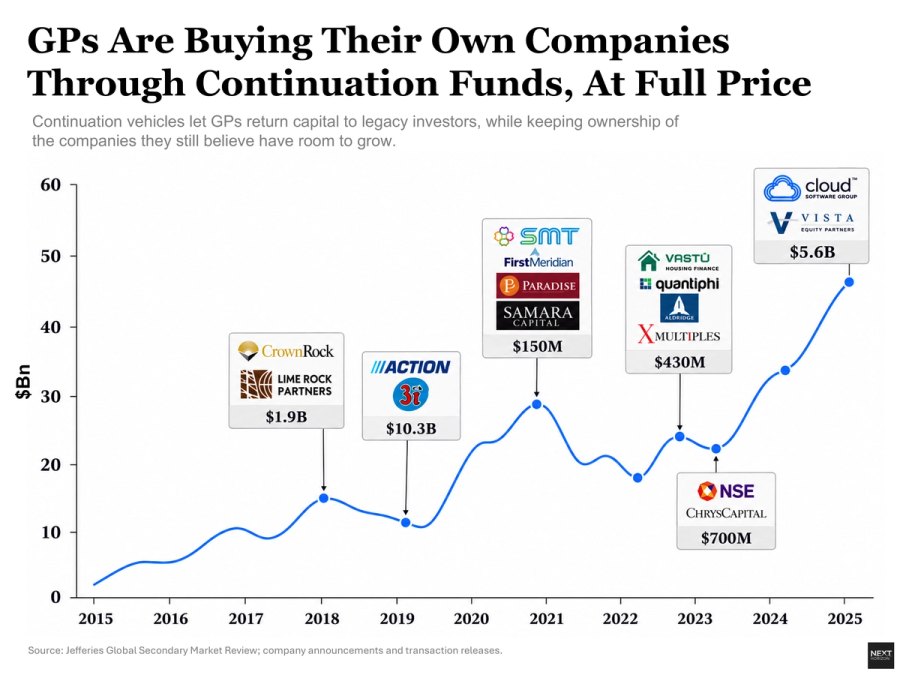
Last week, we covered how the discipline of vintage diversification broke down when private equity deployed the lion’s share of its capital at its highest entry prices. When these assets move to the terminal side of their lifecycles, the stark evolution the mechanism has had for high-quality assets becomes apparent. This week, we’ll cover the background behind this change.
Exemplifying the effect of the data represented above, Lazard shows that 56% of single-asset continuation-fund transactions were priced at, or above NAV. 87% were priced at 90% of NAV or higher. The numbers are rather striking, not because the aforementioned discounts have vanished, but seemingly since quality private assets don’t warrant one. Instead of treating these secondaries as instruments in distress needing to be disposed off, the figures show assets accounting to continuation funds are becoming a mainstream, standard way of extending ownership beyond one PE fund’s lifetime. The assets commanding true premiums no longer need to be sold untimely, confined by the years left for the PE.
The secondary market is beginning to look less like a market for distressed liquidity but one that does not require discounts to enable transfer, since the assets seemingly pay for themselves. This evergreen and private-wealth capital creates a deeper pool of buyers while recognising the asset and linking it to intrinsic quality.
The Discount Is Becoming Selective
A traditional secondary transaction is often driven by a seller’s need for cash. A continuation vehicle can be driven by almost the opposite motivations. The GP does not want to sell yet. Not withstanding the standard life of the fund, the assets need not be confined to the number of years left with the fund. The underlying company may still have years of value creation left along the road. That changes the very framework of a standard secondary transaction; the buyer is no longer being compensated for an incidental burden he would have to bear, but being offered continual exposure to an asset that has already survived the most difficult parts of a private-market thesis. The sponsor, in such a situation, has owned it, developed it and hands-on demonstrated an investment thesis.
This is readily apparent in single-asset continuation vehicles. In 2024, only a relatively small slice of these transactions required deep discounts, while the overwhelming majority cleared at 90% of the NAV or higher. The market demonstrates that it can efficiently differentiate between assets that need a discount to create demand and assets that intrinsically warrant demand.
India’s Exemplary Landscape
The Indian market provides a sparkling illustration of the same phenomenon. The market’s former continuation vehicles were relatively modest, multi-asset structures which were assembled primarily to create liquidity while preserving exposure to businesses that sponsors still wanted to have stakes in. The same exemplified by Samara Capital, established a roughly $150M vehicle, centred around 3 portfolio companies: FirstMeridian, Paradise Food Court & Sahajanand Med Tech.
The structure solved a straightforward concern, one that, in hindsight, seems like it should’ve happened before; existing investors could now take on liquidity, while those who remained bullish could roll their exposure into new vehicles, encouraging injection of new capital.
The transactions that followed this began to look different. In 2024, ChrysCapital raised a $700M continuation vehicle around its stake in NSE. Multiples PE subsequently raised $430M for a vehicle holding Vastu Housing Finance, Quantiphi and APAC Financial Services. The market, hence, moved from a structure that aimed to solve a liquidity issue to one of India’s most valuable financial-market assets. One which has, more surprisingly, risen from the secondary market, with the purpose of extending ownership of the portfolio’s best investments. The secondaries are starting to appear to perform a function that looks increasingly similar to portfolio construction and management thereof.
The Exit Moved on the Same Plane
Continuation funds, by nature, point to a broader change in how PE thinks about exits. The traditional model, linearly following an “invest - appreciate - sell - return capital” timeline, now evolves into a more flexible one that also includes the processes of recapitalisations and continual ownership with an exit that is more eventual than before.
The fund’s legal life no longer has to dictate the asset’s true economic life. The exit shall not be forced by itself. This caveat makes said vehicles less of an emergency liquidity mechanism but more of a permanent piece of market infrastructure. GPs can retain their high-conviction assets, allowing injection of new funds without waiting for a new primary fund life cycle.
The asset has not “changed hands” like an ordinary secondary transaction. The ownership clock has simply been reset. The secondary market was once built around the idea that liquidity warranted a discount. But as we reach the trophy end of the spectrum, it is increasingly becoming a market where investors demand the privilege of having the exposure the asset offers.