The IPO Is Taking Longer. Private Markets Have Built a Side Door.
As companies stay private for longer, secondaries are emerging as an increasingly important source of liquidity for founders, employees, investors and GPs.

For decades, the IPO was the cleanest answer to a simple question: how does a private company turn years of paper value into liquidity? That equation is changing. Companies are staying private for longer, while investors, founders and employees still need ways to realise value before the public markets arrive. MSCI’s latest research captures the structural shift clearly: the median age of companies at IPO has trended upward over time, while the number of venture-backed companies valued at $1 billion or more has crossed 1,200 globally. The longer private phase has created demand for an alternative liquidity venue, and the secondary market is increasingly filling that role.
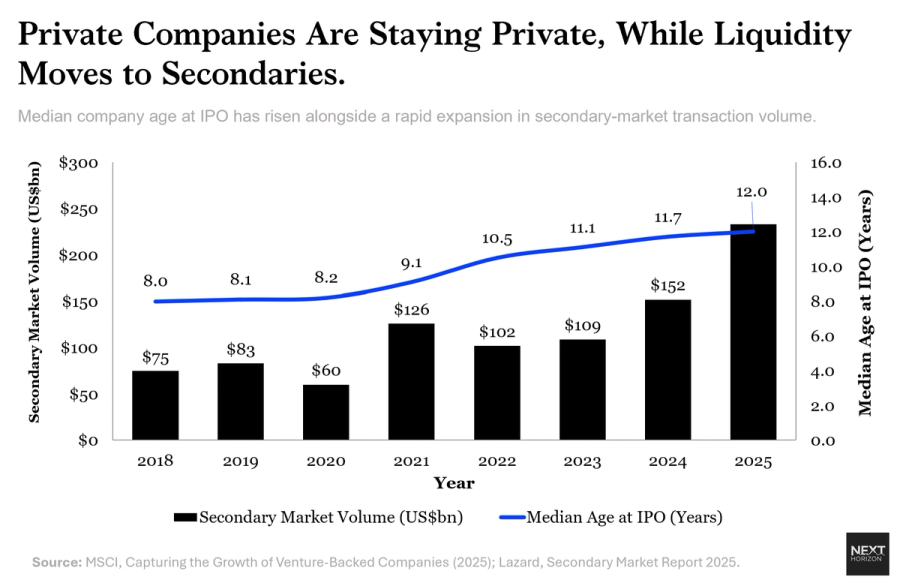
The Exit Is Moving Inside the Private Market
The scale of that shift is difficult to dismiss as a niche phenomenon. Lazard estimates that global secondary transaction volume reached $233 billion in 2025, up 53% from $152 billion in 2024. The market was almost evenly divided between $116 billion of GP-led transactions and $117 billion of LP-led transactions. This is particularly notable because traditional exit markets were recovering at the same time: global IPO issuance increased 48% in 2025 and announced M&A value rose by roughly 40%. Secondaries were not simply filling a vacuum left by a closed IPO market; they were expanding alongside it. Lazard describes the secondary market as becoming an established liquidity tool for sponsors and LPs.
That changes the role of the secondary transaction. It is no longer necessarily a last resort for an investor desperate to sell. GP-led continuation vehicles allow managers to extend the holding period of attractive assets while giving existing investors a route to liquidity. Lazard estimates that ~50% of 2025 secondary volume was GP-led, while GPCA notes that continuation vehicles are increasingly being used to retain high-quality assets rather than simply solve an end-of-fund problem.
India Is Becoming a Test Case
India provides an especially interesting view of this transition. GPCA identifies India as the market that has captured much of Asia's recent secondary momentum. In the last 18 months covered by its August 2025 report, ChrysCapital raised a $700 million continuation vehicle for the National Stock Exchange, followed by Multiples Alternate Asset Management raising $430 million to extend its hold of Vastu Housing Finance, Quantiphi and APAC Financial Services. Chiratae Ventures also sold assets including Lenskart, Bizongo and Rentomojo for $70 million in a direct secondary transaction. GPCA says the Indian market is seeing a deepening pool of both buyers and sellers, including growing international participation.
The more interesting question is whether these transactions represent distressed liquidity. EY's April 2026 analysis suggests they often do not. Looking at 306 concurrent primary and secondary transactions between January 2019 and December 2025, EY found that roughly 85% occurred at the same or higher value than the concurrent primary investment, with discounts of up to 5% treated as immaterial. Only 46 transactions showed discounts greater than 5%, and those transactions recorded an average discount of 19%. The finding suggests that, when primary capital is still validating a company's valuation, secondary liquidity does not necessarily require a meaningful haircut.
But Liquidity Is Not Yet Universal
There is an important caveat. A larger secondary market does not mean every private company is suddenly liquid. MSCI estimates that more than 1,200 venture-backed companies globally are valued at $1 billion or more, but says investors looking to buy shares in the secondary market today are likely limited to fewer than 100 companies. Liquidity remains concentrated in the most sought-after names.
That concentration may be the next opportunity. As secondary trading expands, the market needs better pricing data, greater transparency and more standardised infrastructure. MSCI's launch of venture-backed private-company indexes, built using secondary-market data from specialist providers, is itself evidence of that institutionalisation. What was once an opaque bilateral transaction is gradually becoming a market with observable prices, specialist intermediaries and benchmarks.
The implication is bigger than simply “more startups are doing secondaries.” The private-company lifecycle is being rebuilt around multiple liquidity points. Founders and employees no longer have to view the IPO as the only meaningful monetisation event. GPs can hold high-conviction assets longer without waiting indefinitely for a public listing. LPs can rebalance portfolios without necessarily waiting for fund maturity.
The IPO is not disappearing. It is simply losing its monopoly on liquidity.
The companies and investors building the infrastructure around that shift, pricing, marketplaces, tender offers, continuation vehicles and transaction execution, may ultimately matter as much as the companies waiting to go public.
The private market did not solve the IPO delay.
It built a side door.