₹15.7 Lakh Crore Committed. So Where Is The Capital?
India's AIF industry has accumulated a record pool of committed capital, but less than half had been invested by December 2025. The gap says more about capital absorption than capital scarcity.

Last week, we asked whether the celebrated 35% search-fund IRR actually described the investor's experience. The distinction was between what an asset class reports and what an investor actually receives. This week, the same distinction appears in India's alternative investment industry, but at a different level.
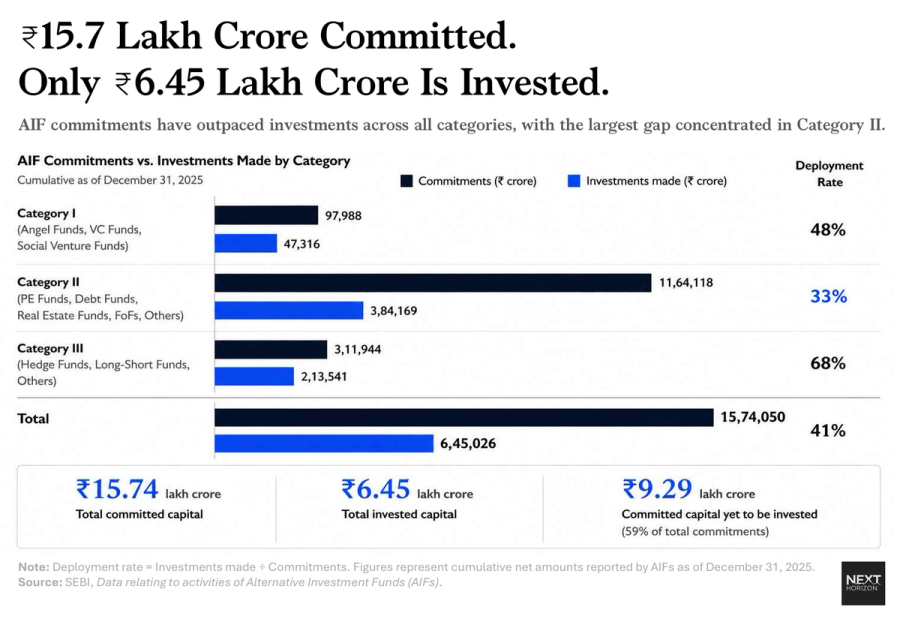
India has no shortage of private capital. What it has is a growing distance between capital committed and capital invested. By December 2025, India's AIF industry had accumulated ₹15.74 lakh crore of commitments. Investments made stood at ₹6.45 lakh crore. That leaves roughly ₹9.29 lakh crore of committed capital that had not yet been invested.
The headline number therefore needs a second number beside it. ₹15.74 lakh crore is the industry's capital capacity. ₹6.45 lakh crore is the capital that has actually gone to work.That distinction matters.
The Gap Is Concentrated Where Private Markets Are Most Private
The divergence becomes clearer inside Category II, which accounted for ₹11.64 lakh crore, or roughly 74%, of total AIF commitments at the end of 2025. Investments made by Category II funds stood at ₹3.84 lakh crore, implying deployment of approximately 33% of commitments. Category III, by comparison, had invested ₹2.14 lakh crore against ₹3.12 lakh crore of commitments, or roughly 68%. The difference is not surprising.
Category II encompasses much of India's private-market infrastructure: private equity, private credit, real estate and other strategies investing across less-liquid assets. These funds are designed to deploy capital over time rather than immediately convert commitments into investments.
That makes the ₹9.29 lakh crore gap less useful as a measure of "idle capital" than it first appears. It is better understood as a pool of committed but not-yet-deployed capital, and that distinction changes the question.
India Doesn't Have A Funding Shortage
The broader investment data makes that clear. Indian PE/VC investment reached $60.7 billion across 1,475 deals in 2025, up 8% in value and 9% in volume year on year. Fundraising was even stronger: $23.2 billion, more than double the $9.8 billion raised in 2024. Deal count also reached a record high.
The contrast with 2024 is instructive. Venture funding had already rebounded to $13.7 billion, up 43% from 2023, while deal count jumped from 880 to 1,270. Yet VC fundraising fell 35% to $2.7 billion, its lowest level since 2020.Capital was therefore moving through the system even when new fundraising was weak.
The same is now true in reverse: capital commitments are abundant even as not all of that capacity has yet translated into investments.
The Real Constraint Is Absorption
This is where the ₹15.74 lakh crore figure becomes more interesting. CRISIL's analysis shows AIF commitments grew at a 31.5% CAGR between FY21 and FY25, reaching ₹13.49 lakh crore by March 2025. By September 2025, more than 1,600 AIFs were registered with SEBI, with approximately 61% registered during the preceding four-and-a-half years.
The industry's capacity has therefore expanded rapidly. But capital formation and capital deployment do not move at the same speed.
The investment committee still has to approve the deal. The valuation still has to make sense. The fund still has to underwrite the business. And the manager still has to believe the return justifies locking up capital for years.
That is why the most useful interpretation of India's undeployed AIF capital is not that ₹9.29 lakh crore is sitting uselessly on the sidelines.
It is that India has accumulated a substantial forward pipeline of capital capacity, while the market still has to produce enough opportunities at valuations that justify putting it to work.
That is a more demanding question than whether India has enough money.
The next constraint may not be capital. It may be the supply of investable opportunities good enough to absorb it.