India’s VC Market Is Deploying Faster Than It Is Raising
India’s venture deployment recovery is two years old. The harder question now sits upstream: can the GPs writing those checks still raise the next fund?

Few narratives have aged this poorly. “Funding winter” has meant one thing for three years: founders can’t raise. The data increasingly says otherwise.
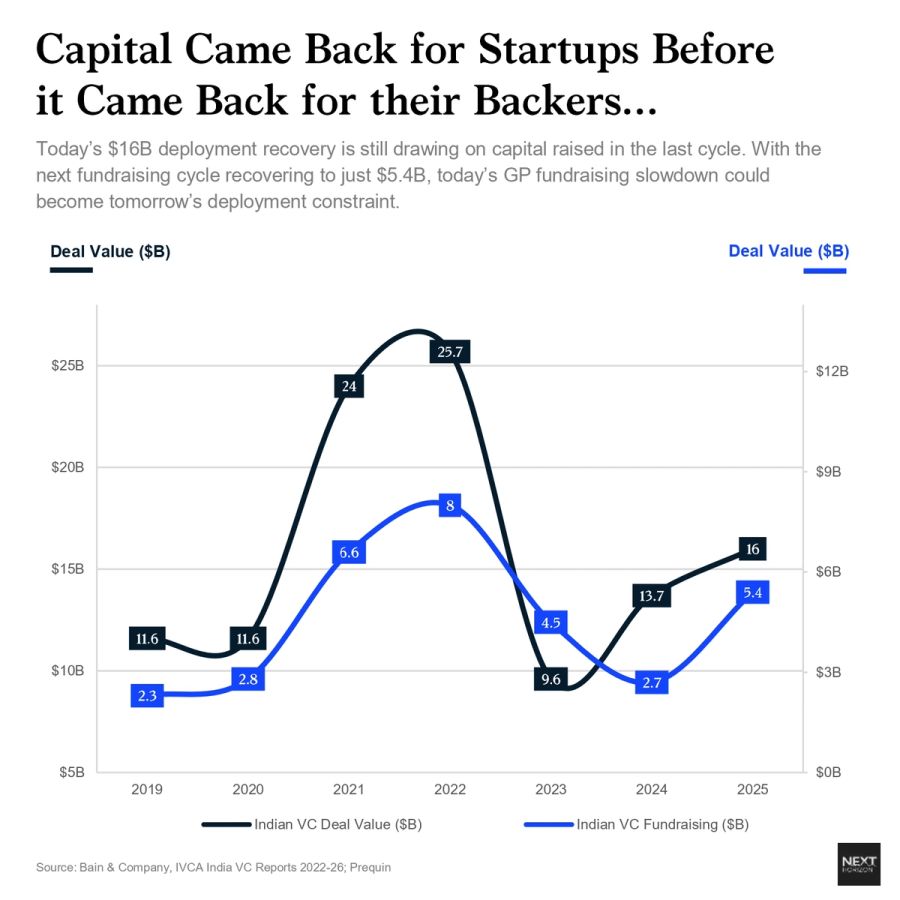
Indian venture deal value bottomed at $9.6bn in 2023, down from $25.7bn the year before. By 2024 it had climbed back to $13.7bn. By 2025, roughly $16bn. The recovery in deployment is now two years old, even as the language surrounding the market has scarcely moved on from its trough.
Fund-level fundraising moved on a different clock. Capital raised by India-focused VC and growth funds hit a record $8bn in 2022, then collapsed past the 2023 low, bottoming at $2.7bn in 2024, a full year after deal value had already turned. It clawed back to about $5.4bn in 2025. Deployment found its floor first. Fundraising followed a year later, and remains some distance from its previous peak.
Here’s the part getting missed: deal count barely moved.
The recovery in deal value didn’t come from more companies getting funded. It came from bigger checks going to fewer of them.
Someone's going to point at that 2025 fundraising rebound (nearly double the 2024 number) and say the trust problem is over, GPs can raise again. That's a fair read of one year of data. It's also the wrong frame, because the more precise signal was never the aggregate fundraising number. It's where inside the system that capital is actually going.
SEBI's Alternative Investment Fund data answers that question, and it's been building for a decade, not a year. Category I - the classification that houses India's registered venture capital funds, the vehicles a generation of LPs used to back a single manager's judgment for ten years, held 48% of total AIF commitments in FY14, and by September 2025, after total industry commitments had grown more than a hundredfold, it held just 6%. Category III, built for listed, liquid, hedge-fund-style strategies, moved the other way: under 13% two years ago, over 19% now.
The decade-long change in the composition of India’s alternative capital pool is difficult to ignore. Capital has become more discriminating about where it sits, how long it stays there, and whose judgement it is prepared to underwrite.
The shift extends well beyond India. UBS's family offices are cutting private equity from a 2023 peak of 22% toward a planned 18%, while private debt allocations double, 2% to 4%, on their way to 5%. McKinsey counts new PE firm formation falling roughly 18% a year since 2020. PitchBook found twelve firms took more than half of all global VC raised in the first half of 2025.
Liquidity is not the bottleneck
If liquidity were the problem, these numbers would look very different. Global secondaries volume reached a record $240bn in 2025, up 48% from $162bn the year before. Investors are trading existing exposure faster than ever, while new fund formation continues to slow.
The bottleneck didn't disappear when dealmaking recovered.
It moved upstream. In 2023, the central question was whether a founder could persuade a GP to finance the next five years. Increasingly, the harder question is whether that GP can persuade an LP to finance the next ten.
The question 2026 has to answer
What we don't know yet is whether 2025's fundraising rebound is the start of LPs re-committing to single-manager venture vehicles, or a one-year outlier inside a ten-year structural shift away from them. The SEBI numbers say structural. One good year in Bain's aggregate isn't enough evidence to say otherwise yet.