The Price of Liquidity
The shift towards liquid alternatives has changed the economics of generating alpha.

Last week, we argued that India's funding winter did not end when startup investment recovered. It simply moved upstream. Venture deployment found its footing in 2024, while fundraising remained under pressure, revealing that the constraint had shifted from founders seeking capital to fund managers seeking commitments.
That naturally leaves another question. If capital became more selective about backing venture funds, where did it go instead?
The answer is visible in India's alternatives industry. By the end of 2025, cumulative commitments to Alternative Investment Funds had crossed
Within that expansion, Category III AIFs emerged as the fastest-growing segment, with commitments exceeding ₹3 lakh crore and growing materially faster than the rest of the industry.
The migration is hardly surprising.
After two years of delayed exits, frozen IPO markets and illiquid portfolios, investors began assigning a premium to flexibility. Daily NAVs became more attractive than decade-long lockups. Liquidity ceased to be merely a portfolio feature. It became an investment objective.
Markets have always behaved this way.
Every cycle changes what investors believe is scarce. After the global financial crisis, safety became paramount. Following the post-pandemic technology boom, profitability returned to favour. The correction of 2022 and 2023 produced a different instinct. Investors increasingly preferred assets they could value daily, redeem more frequently and explain more easily to investment committees.
Capital followed those preferences.
Whether superior liquidity translated into superior outcomes is a more difficult question.
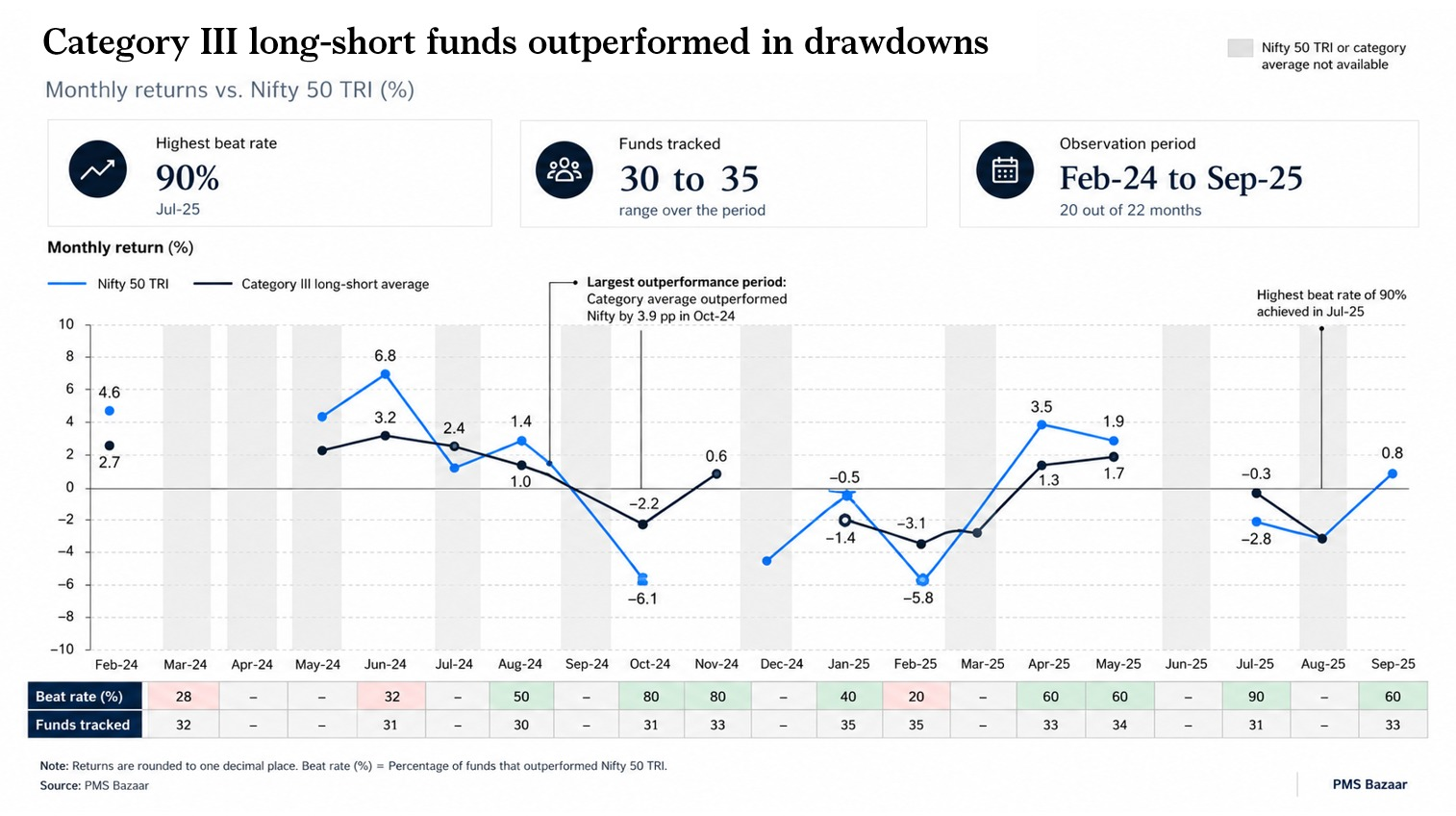
Unlike venture capital, Category III asks investors to clear a considerably higher hurdle before value is created. Management fees, performance fees, taxation in many structures and manager selection risk all sit between the investor and the underlying market return. The comparison is no longer against cash. It is against increasingly inexpensive passive exposure.
That changes the economics of active management.
A low-cost index fund begins every year only a few basis points behind the market. An actively managed Category III fund begins with a materially higher cost structure. Every percentage point of alpha must therefore be earned before excess return reaches the investor.
Recent benchmark data illustrates that dispersion has become the defining feature of private capital. Some managers continue to generate exceptional outcomes. Many do not. McKinsey makes a similar observation globally. As private markets mature, excess returns are becoming less a product of favourable markets and increasingly a function of manager selection, operational execution and disciplined capital allocation. Alpha, in other words, is becoming harder earned rather than broadly available.
The migration from venture capital towards more liquid strategies was understandable. Yet every investment cycle carries the risk of solving yesterday's problem at tomorrow's cost. Liquidity is valuable. So is optionality. Neither, however, is a substitute for long-term compounding.
The history of capital markets is remarkably consistent on this point. Investors rarely buy what is objectively cheap. They buy what recently became emotionally scarce.
Last week, we argued that the funding bottleneck had moved upstream. This week, the evidence suggests something equally interesting. Capital moved as well. It did not become more impatient. It became more selective about certainty. Whether that preference proves rewarding will depend less on the asset class than on whether the manager can overcome the increasingly expensive hurdle that certainty now demands.