The Search Fund Mirage: Why 35% IRR Isn't Your Return
A new Yale study reveals why the celebrated 35.1% IRR reflects the performance of an ecosystem, not the experience of the average investor.

Last week, we argued that private equity's return engine has fundamentally changed. Multiple expansion is no longer doing the heavy lifting. Returns increasingly have to be earned through operational improvement rather than financial engineering.
This week, we move one layer further upstream.
Before debating how private markets generate returns, it is worth asking a simpler question.
How much of the industry's reported performance actually belongs to the average investor?
Few asset classes illustrate this better than search funds. For nearly four decades, the Stanford Graduate School of Business Search Fund Study has been the industry's definitive scoreboard. Its latest figures are extraordinary: a 35.1% internal rate of return and a 4.5x multiple on invested capital. Those numbers have become the asset class's calling card, repeated across fundraising decks, MBA classrooms, podcasts and conference panels as evidence that Entrepreneurship Through Acquisition is among the most attractive strategies in private markets.
Then, in October 2025, researchers at Yale School of Management asked a different question. Instead of measuring the headline performance of the asset class, they measured the returns that investors actually experienced across portfolios. The distinction sounds subtle. It isn't. One describes an ecosystem. The other describes an investor's reality. Once those two concepts are separated, one of private markets' most celebrated performance statistics begins to look remarkably fragile.
The Average Was Never Typical
The Yale study examined 1,192 individual search fund investments, one of the largest deal-level datasets assembled for the strategy. Its conclusion was not that Stanford's numbers were incorrect. Rather, they were statistically misleading as a representation of what most investors should expect.
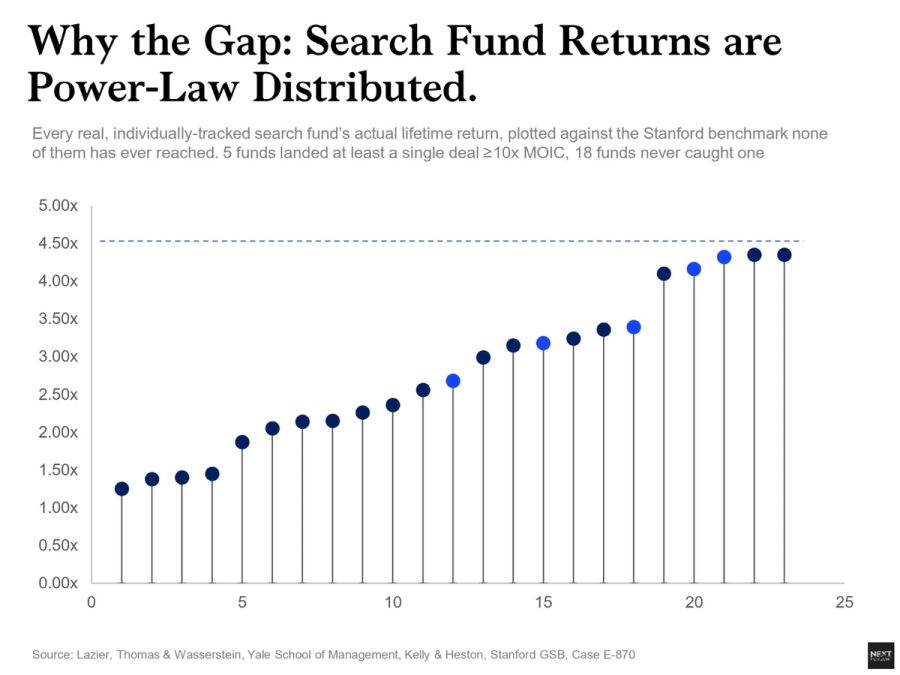
Returns followed an unmistakable power-law distribution. A very small number of extraordinary outcomes accounted for a disproportionate share of the asset class's aggregate performance, while the majority of investments generated far more modest results. Approximately 58% of individual deals returned less than 2x invested capital, and only a handful produced the exceptional outcomes that lift the overall average to 35% IRR.
This phenomenon is hardly unique to search funds. Venture capital has long exhibited similar characteristics, where a small number of companies create most fund returns. What makes search funds different is how frequently the headline statistic is presented without equal emphasis on the underlying distribution. Investors naturally anchor on averages, even when averages describe almost nobody.
The practical implication is significant. A headline return measures the performance of an asset class. It does not necessarily describe the experience of a diversified investor operating within that asset class. Those are fundamentally different questions, yet they are often treated as interchangeable.
Portfolio Construction Matters More Than Manager Selection
The Yale findings also shift attention toward something institutional investors have understood for years but individual investors often underestimate: portfolio construction matters as much as manager selection.
A power-law distribution changes the mathematics of diversification. Missing a small number of exceptional outcomes can dramatically reduce realised returns, while adding additional median-performing investments contributes comparatively little. In other words, the portfolio's success depends less on consistently finding "good" companies than on ensuring exposure to the rare companies that become extraordinary ones.
This explains why many sophisticated allocators evaluate private markets differently from retail investors. They underwrite portfolios rather than individual deals. They expect a meaningful proportion of investments to underperform because they recognise that exceptional outliers ultimately drive aggregate returns.
The Yale paper demonstrates that many investor portfolios never captured enough of these outliers to resemble the celebrated Stanford benchmark. The average investor was participating in the same asset class but experiencing an entirely different return profile. The benchmark remained mathematically accurate while simultaneously becoming practically unattainable for most participants.
It is a useful reminder that averages often conceal more information than they reveal.
The Right Benchmark Isn't The Average. It's The Distribution.
The broader lesson extends well beyond search funds. Private markets increasingly celebrate headline statistics because they are simple to communicate. Average IRRs, median exit multiples and aggregate MOICs fit neatly into presentation slides and investment memoranda. Distributions do not.
Yet distributions determine outcomes.
The relevant question for investors is no longer "What did this asset class earn?" but rather "What is the probability that my portfolio earns it?" Those are entirely different underwriting exercises.
For search funds, the Yale evidence suggests the celebrated 35.1% IRR should be viewed less as an expected return and more as a description of what becomes possible when an investor successfully captures a very small number of exceptional businesses. That is a meaningful distinction. It changes how portfolios should be built, how capital should be diversified and, perhaps most importantly, how expectations should be set.
As private markets continue to mature, investors may need to become more sceptical of averages altogether. The next generation of superior allocators will not simply ask what the benchmark was. They will ask how many investors actually reached it.