The Whitespace in AI × Travel: The Chatbot Isn't Enough
Why the next opportunity in travel AI may lie beyond recommendations, in the systems that can actually execute the journey.

Travel may be one of the clearest examples of an AI category where the interface is advancing faster than the underlying business model. Every major travel platform can now generate an itinerary, recommend a hotel or answer a destination question. The experience looks dramatically better, but the economics are less obvious. The more interesting question is therefore not whether AI can make travel planning easier, but where it can actually change the economics of the travel transaction.
The First Wave Is Already Becoming a Commodity
Generative AI has entered travel quickly. Amadeus found that the share of travellers using GenAI for travel planning increased from 11% to 18% in 2025, yet 25% of users reported receiving outdated or inaccurate information. The adoption curve is revealing: consumers are increasingly comfortable asking AI for advice, but considerably less comfortable allowing it to act. McKinsey and Skift found that more than 90% of travellers have some confidence in AI-generated travel information, while only 2% are willing to let AI take full control of booking or modifying a trip without human oversight. The implication is that the first generation of travel AI competes primarily on information. Destination research, itineraries and recommendations are becoming increasingly easy to generate, making the interface itself difficult to defend. The next economic opportunity therefore has to sit further downstream, where AI can influence the transaction rather than simply improve the conversation around it.
The Value Moves When AI Can Act
The difference between an AI assistant and an AI agent is ultimately economic. An assistant can tell a traveller that a delayed flight may cause them to miss their hotel check-in. An agent could potentially identify the problem, search alternatives and execute the necessary changes. Travel contains an enormous number of these repetitive decisions: bookings change, connections move, cancellations occur, customers request refunds and itineraries have to be rearranged. These are not fundamentally conversational problems. They are workflow problems. EY's analysis of more than 10,000 tasks across Indian enterprises estimates potential GenAI productivity gains of 80% in call-centre management and 44% in customer service. Travel is particularly suited to this transition because significant operating costs sit behind the customer experience in support, booking changes, reconciliation, disruption management and supplier coordination. The economic value of AI may therefore come less from producing a better answer and more from eliminating the work that follows the answer.
India Adds Another Layer of Opportunity
India makes this opportunity particularly interesting because rapid digital adoption sits alongside a highly fragmented supply base. Alongside airlines and large OTAs sits a long tail of hotels, homestays, local transport providers, guides and regional experiences, much of which remains difficult to discover, compare or transact through conventional digital interfaces. This creates two potential opportunities. The first is making existing digital inventory easier to transact. The second is making previously inaccessible inventory legible to machines and consumers. An AI system capable of understanding unstructured descriptions, regional preferences, languages and highly localised experiences could potentially turn fragmented supply into searchable and eventually bookable inventory. The opportunity is therefore not simply a better travel search engine. It is better market-making infrastructure for an industry with enormous amounts of poorly surfaced supply.
The Agentic Travel Opportunity Is Still Early
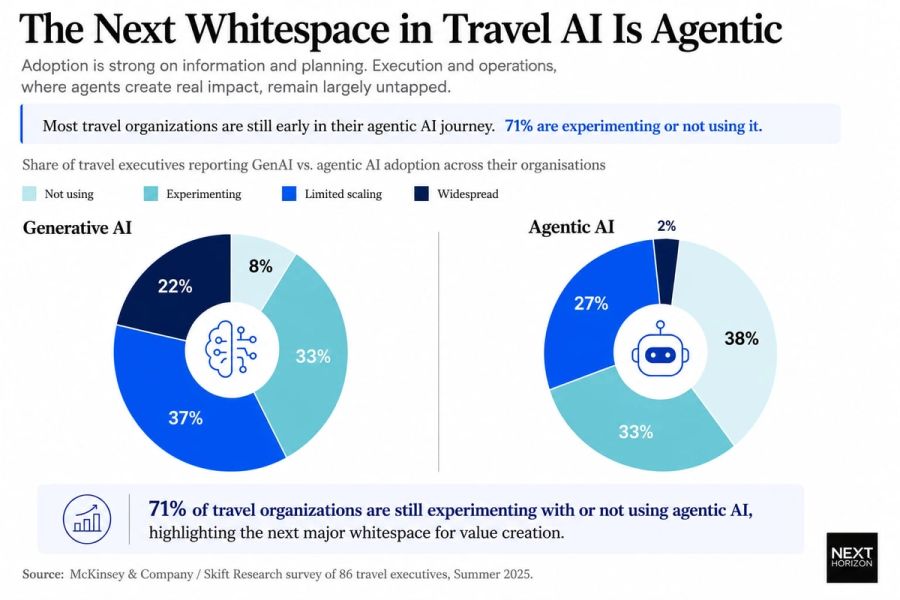
The technology is moving, but adoption shows how early the market remains. McKinsey's survey of travel executives found that 90% already use generative AI somewhere in their organisations, while only 2% report widespread use of agentic AI. The industry has largely figured out how to put AI in front of the customer. It has not yet figured out how to give AI enough access to inventory, systems and workflows to make it economically consequential. That is where the interesting companies may emerge: not necessarily another chatbot or itinerary generator, but products that sit deeper in the transaction, where AI can reduce operating costs, increase conversion, surface fragmented supply or execute decisions that previously required human intervention. The first wave of travel AI made the interface smarter. The next wave will have to make the transaction itself smarter.