When an Exit Isn't Really an Exit
Exit activity has recovered, but distributions haven't. As private equity invents new ways to create liquidity, the industry's biggest challenge is no longer selling companies, it's returning cash to investors.

Private equity appears to have turned a corner. Global buyout deal value rose 44% to $904 billion in 2025, while exit value climbed 47% to $717 billion, making it the industry's second-best year on record after 2021. On paper, the liquidity problem seems to be easing.
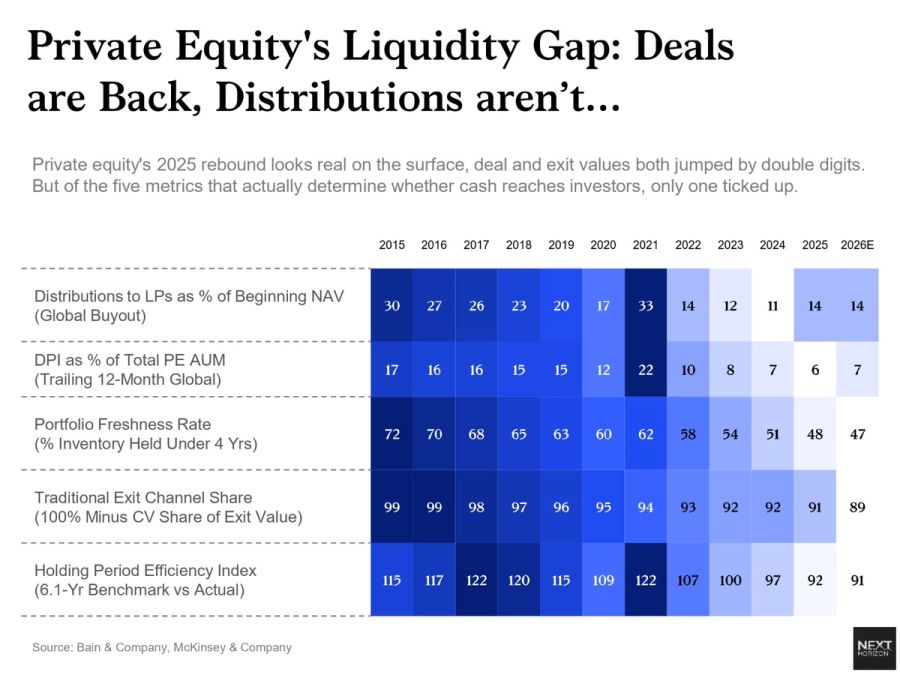
Yet beneath the headline numbers lies a more uncomfortable reality.
Cash is still not flowing back to investors the way it once did.
Bain notes that distributions as a percentage of net asset value have remained below 15% for four consecutive years, the longest stretch on record. Meanwhile, private equity firms continue to hold roughly 32,000 unsold companies worth $3.8 trillion, as managers delay exits in the hope that stronger earnings or better market conditions justify higher valuations.
That distinction matters because liquidity is not measured by transaction activity alone. It is measured by capital returning to limited partners.
Private equity has become remarkably efficient at creating transactions. It has become far less efficient at generating distributions.
This is where the industry's newest liquidity mechanisms come into focus.
Continuation vehicles, GP-led secondaries, NAV lending and sponsor-to-sponsor transactions have all grown rapidly in recent years. Each solves a genuine problem. Each creates optionality for investors. But they also share something important: they often move assets within the private-markets ecosystem rather than transferring them into public ownership or strategic hands.
The result is an industry increasingly capable of recycling ownership without necessarily expanding realised liquidity.
Bain itself is careful not to overstate these tools. Continuation vehicles currently account for less than 10% of global exit value, providing flexibility for managers but representing only a partial answer to the industry's liquidity challenge.
McKinsey reaches a remarkably similar conclusion.
Although dealmaking returned forcefully in 2025, liquidity for investors remains "more a trickle than a flood." More than 16,000 buyout-backed companies have now been held for over four years, representing 52% of total buyout inventory, the highest level on record. Average holding periods exceed six and a half years, while secondaries, continuation vehicles and NAV lending have evolved from temporary responses into structural features of modern private equity.
Perhaps the most telling statistic concerns distributions themselves.
McKinsey estimates that DPI as a share of total private equity AUM fell to just 6% in the twelve months ending June 2025, compared with an average of 16% between 2015 and 2019. On a rolling five-year basis, cash returned to investors relative to industry assets reached its lowest level on record, even as secondaries trading volume expanded 48% during 2025.
None of this means private equity is broken.
Quite the opposite.
The industry's innovation around liquidity has been extraordinary. Funds have developed increasingly sophisticated ways to extend ownership, accommodate investor preferences and avoid becoming hostage to frozen IPO markets.
But innovation should not be mistaken for resolution.
The industry's central challenge has not disappeared. It has changed shape.
Last week we argued that the venture capital bottleneck moved upstream, from founders raising capital to fund managers raising it.
Private equity is experiencing a similar evolution.
The question is no longer whether firms can execute exits.
It is whether those exits ultimately return enough cash to investors to finance the next generation of funds.